
Roche is redesigning its R&D operating model.
Who does the work, where human expertise carries the most value, and why the logic reaches well beyond pharma.
6 min read
Roche has started building autonomous, AI-driven laboratories. The technology story travels fast: connected instruments, AI agents planning experiments, robotics executing them, automated systems generating machine-checkable evidence.
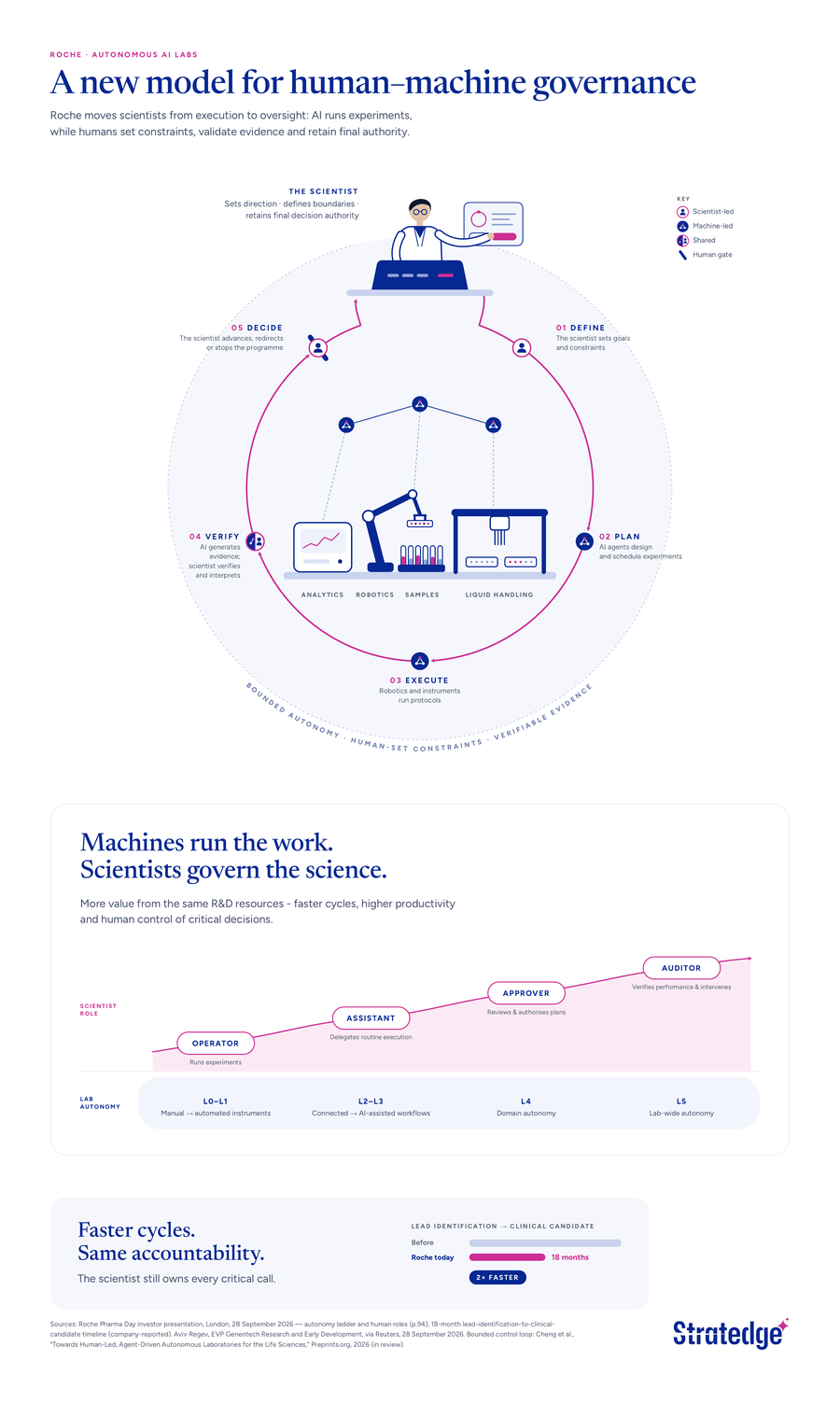
The more interesting shift is what happens to the scientist. As the lab takes on more of the execution, the scientist's role moves upstream — from operator, to assistant, to approver, to auditor. The work does not disappear. It concentrates on the decisions that carry the most consequence.
More autonomy does not mean less accountability. This is the substantive lesson for every enterprise, not only for pharma.
The autonomy ladder.
Roche's operating model progressively shifts experimental work from manual to lab-wide autonomy. The ladder is not a single technology choice. It is a sequence of design decisions — what work is automated, what evidence is generated automatically, what stays under direct human control, and what triggers escalation.
Fully manual · assisted execution · supervised automation · lab-wide autonomy. Each stage reallocates the division of labour between humans, instruments, agents, and robotics. And each stage carries its own governance question: what has to be true for the organisation to move up a rung without giving up its accountability?
The decision to advance is not primarily technical. It is a governance decision — about where evidence can be machine-checked, where human judgement remains the control point, and where the cost of a wrong outcome demands a human in the loop rather than after it.
From operator to auditor.
As execution moves to machines, the scientist's role moves through four stages: Operator, Assistant, Approver, Auditor. Each stage is a different question about human contribution.
At the Operator stage, the scientist runs the experiment. At the Assistant stage, AI helps plan and prepare; the scientist still executes and decides.
At the Approver stage, machines execute; the scientist reviews outputs, validates evidence, and gives sign-off before results are used. Human judgement moves closer to the point of consequence and further from the point of execution.
At the Auditor stage, machines execute and self-verify against defined limits. The scientist sets goals and constraints, interprets results at portfolio level, and retains authority over high-consequence decisions. Expertise concentrates where it produces the highest return.
This progression is what unlocks the productivity case: shorter iteration cycles, more experimental work per scientist, and scientific expertise focused on decisions that allocate resources and drive portfolio value. But the productivity case only holds if the accountability question is answered at every rung.
The same logic reshapes any expert-driven work.
The autonomy ladder is not a pharma-specific pattern. It is the underlying shape of enterprise AI as it matures across regulated, expert-heavy industries.
In manufacturing and engineering, the same logic compresses the design–prototype–test–learn cycle. AI generates design options, robotics builds and tests, digital twins simulate performance, data feeds the next iteration. Human expertise moves upstream — setting goals and constraints, weighing trade-offs, validating quality, and deciding what moves into production.
In financial services, credit underwriting, fraud detection, and portfolio analysis follow the same arc. Machines handle volume; specialists concentrate on judgement, exception handling, and the decisions that determine institutional exposure.
In healthcare, clinical decision support, diagnostic imaging, and care-pathway design follow the same logic. Clinicians move from doing to directing — from executing every step to setting the constraints within which machines execute and validating outcomes at the point of consequence.
The common pattern is that AI takes the work, and humans keep the decisions. Value now sits where expertise is deployed, not where it is expended.
Governance as design, not compliance.
The Roche model is bounded: machines operate within defined limits, humans remain responsible for the critical decisions. That boundedness is the design principle European Boards and executive teams need to internalise.
Human-machine governance is no longer a compliance overlay. It is a productivity driver. Where the boundary is drawn — what machines decide, what humans decide, what triggers escalation, what evidence is generated automatically, what is reviewed — determines both the speed of the organisation and the resilience of its accountability.
Boards asking the right questions about human oversight are not slowing AI adoption. They are shaping the design decisions that decide whether AI compounds — or exposes.
Executive teams designing operating models around this logic are not adding governance to their AI programmes. They are building AI programmes that hold under scrutiny — from regulators, from customers, from the workforce, and from their own risk committees.
Where this leaves leaders.
Roche's autonomous labs are the visible signal of a broader shift. The enterprises capturing sustained value from AI are those redesigning how humans and machines divide work — and where accountability sits at each rung of that division.
The Boards and executive teams that treat human-machine governance as a design question, not a compliance question, are the ones building AI capability that compounds. The rest will keep running pilots that never reach the P&L.
This is the work we do with the Boards and executive teams we advise — moving AI from experimentation to structural advantage, with the accountability the role now demands.
Turn this insight into action.
Book a 30-minute conversation with StratEdge to explore what this means for your Board, executive team or organisation.
Book a meetingData governance: from mere compliance to value creation. An IP-driven perspective
In most boardrooms, data is discussed as a compliance risk. Data and intellectual property are intertwined, and IP experts must deep dive into data governance.
[ ART_01 ]Recognising women in AI: Advancing responsible AI leadership
We are proud to share that Barbara Cresti, our founder, has been nominated by the #WOMENINAI and #ONEMILLIONWOMEN initiatives for her commitment to responsible AI and stronger AI governance in boardrooms. This recognition reinforces our belief that shaping the future of AI requires diverse perspectives, inclusive leadership and accountable decision-making.
[ ART_02 ]Practical AI Governance in Switzerland: What Companies Are Learning from Early Adoption and Pilots
A research across four Swiss sectors on how organisations are building AI governance before legislation arrives. By Caroline Perriard, StratEdge, and Rebecca Hubert Scherler, Women in AI Switzerland.
[ ART_04 ]