
The Invisible 80% of AI Transformation
For every $1 spent on AI technology, another $4 goes into people and processes. Why transformation stalls — and what boards must change.
3 min read
For every $1 an organisation spends on AI technology — models, licences, tools, infrastructure — it needs to invest $4 in people and processes. That 4:1 ratio, from Bain & Company's Technology Report 2026, reframes where transformation actually happens. Technology is 20% of the equation. The other 80% is organisational change.
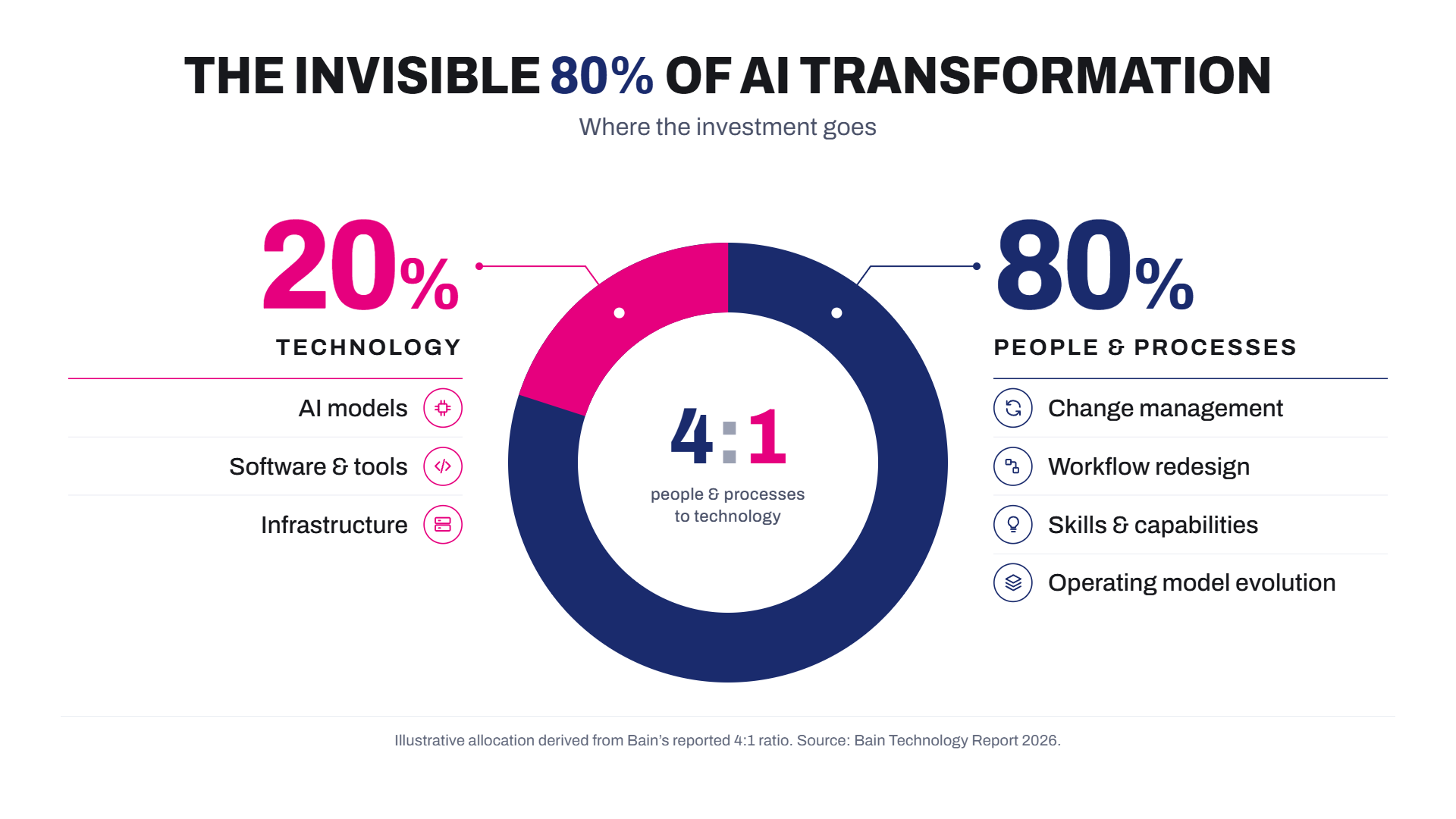
Most boards are watching the 20% that is visible — and missing the 80% that decides the outcome.
When leadership becomes the barrier
Bain estimates that 90% of enterprises remain focused on AI tools and isolated use cases — without clear business targets or effective change management. The result is predictable: productivity may improve, but revenue and earnings do not.
The barriers most often underestimated are not security concerns or ROI uncertainty. They are organisational: weak executive sponsorship, resistance to new ways of working, and the absence of cross-functional accountability. These are leadership failures, not technology failures.
When everyone delivers, but nothing changes
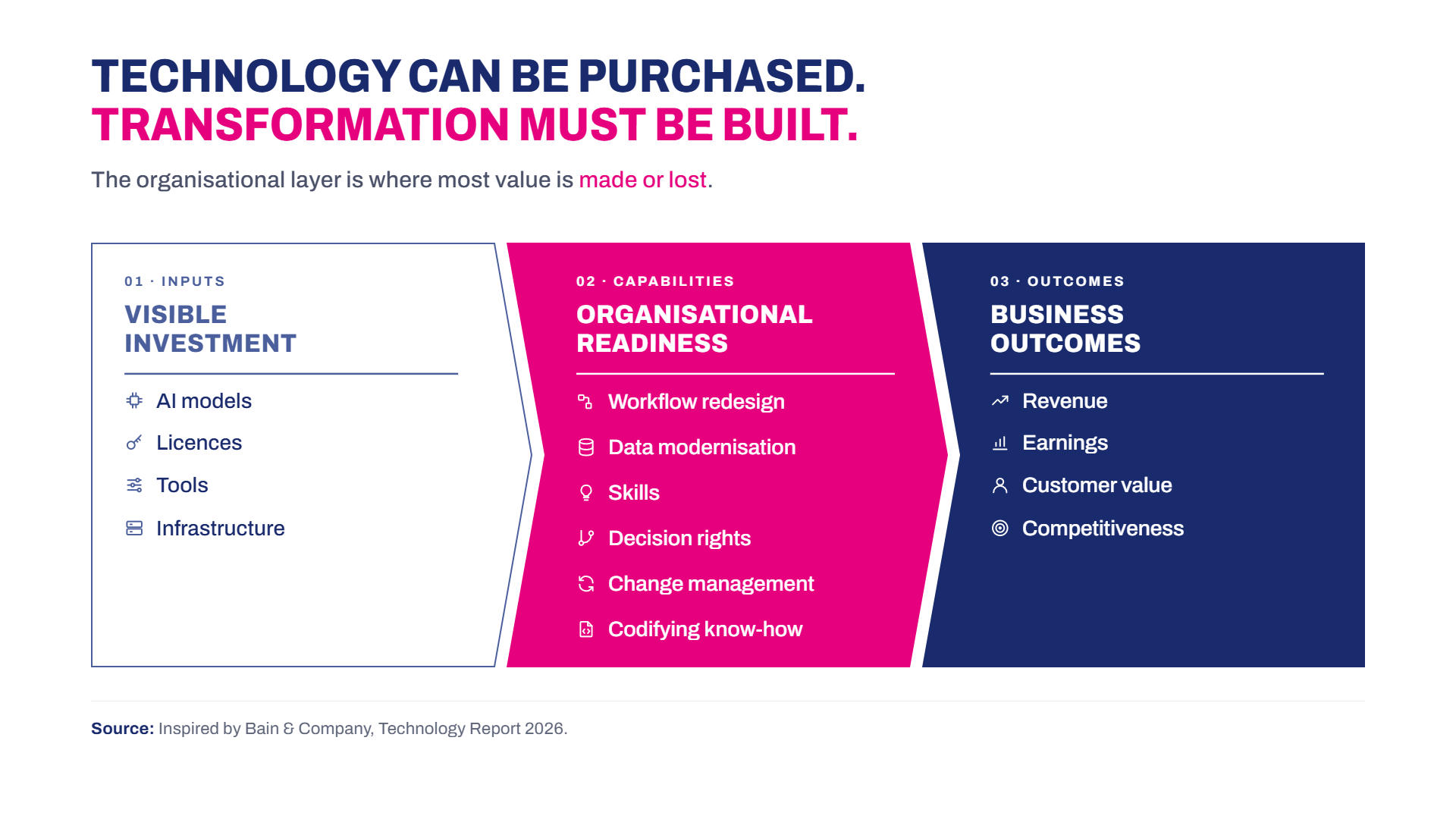
Bain’s report introduces the concept of AI absorption — a measure of how quickly an organisation converts advances in AI capability into realised business value. When AI technology evolves faster than an organisation’s operating model, the gap between what is technically possible and what the business actually captures widens.
For boards, monitoring AI absorption — not just AI adoption — is the more reliable leading indicator of long-term competitiveness.
Companies where AI transformation is led from the C-suite report 10%–25% EBITDA growth. That performance gap cannot be attributed to the technology alone. It reflects the organisational changes that C-suite leadership makes possible: executive alignment, cross-functional accountability, and deliberate change management.
The new leadership test
Bain’s report identifies three indicators boards should monitor — not as a compliance checklist, but as a diagnostic of whether leadership is genuinely enabling transformation.
Business transformation. Measurable business impact beyond productivity gains — revenue growth, earnings improvement, new business models.
Collective accountability. Executive incentives aligned with corporate results, not functional targets. Transformation that rewards the team, not the silo.
Leadership adaptability. Knowing what to change, what to challenge, and what to leave behind — including the practices that once made the business successful.
Sources: Bain & Company, Technology Report 2026.
FAQs
Turn this insight into action.
Book a 30-minute conversation with StratEdge to explore what this means for your Board, executive team or organisation.
Book a meetingData governance: from mere compliance to value creation. An IP-driven perspective
In most boardrooms, data is discussed as a compliance risk. Data and intellectual property are intertwined, and IP experts must deep dive into data governance.
[ ART_02 ]Recognising women in AI: Advancing responsible AI leadership
We are proud to share that Barbara Cresti, our founder, has been nominated by the #WOMENINAI and #ONEMILLIONWOMEN initiatives for her commitment to responsible AI and stronger AI governance in boardrooms. This recognition reinforces our belief that shaping the future of AI requires diverse perspectives, inclusive leadership and accountable decision-making.
[ ART_03 ]Roche is redesigning its R&D operating model.
Roche is shifting its scientists' roles from operators to governors of its autonomous AI labs. A new operating model for R&D that could serve as a playbook to other industries.
[ ART_04 ]